

The purpose of this tutorial is to introduce and review information needed to gain a better understanding and appreciation for the Mitzvah of Mezuzah, (as well as Tefillin). It is meant as a supplement to studying these topics at their source in the code of Jewish law, as well as instruction from your local orthodox Rabbi or experienced mentor in Judaism.
In 1974, the Lubavitcher Rebbe launched a worldwide campaign focusing on increasing the knowledge and practice of mezuzah and tefillin. The Rebbe also encouraged all Jews to have their tefillin and mezuzahs checked by qualified scribes.
In the selection of kosher mezuzahs and tefilin, as well as the encouragement of their periodic checking.
When a defective mezuzah is affixed to a doorpost, the mitzvah of mezuzah has not been fulfilled. If there is a flaw in the scrolls of a pair of tefillin, the person wearing them is not performing the mitzvah of tefillin. Because these mitzvos are so important—and because mezuzahs and tefillin represent a significant financial investment—it is vital that the purchasers of these articles be educated consumers.
A mezuzah has 713 letters, the tefillin 3,188. Every letter has a number of laws pertaining to its form. In order for mezuzahs or tefillin to be written in accordance with all of the laws, it must thus meet thousands of requirements. If even one of the 713 letters in a mezuzah is missing or shaped incorrectly, the mezuzah is rendered invalid, the Mitzvah is unfulfilled, and the b’racha recited over it is in vain. Even the best scribe is human and subject to error. While some errors may be corrected in accordance with halachic decree, others cannot. Mezuzahs and tefillin, even when written by the most expert of scribes, have many possibilities of being unfit. They must therefore be inspected before being purchased.
Furthermore, mezuzahs and tefillin, like anything else subject to the ravages of time and elements, can deteriorate. It therefore behooves us to inspect our mezuzahs and tefillin from time to time, either for the purpose of determining their fitness or for making preventative corrections. The halacha sets the requirements for periodic inspection of the mezuzah at every 3½ years.
Proper placement of Mezuzah
WHERE, EXACTLY, IS THE MEZUZAH TO BE MOUNTED?
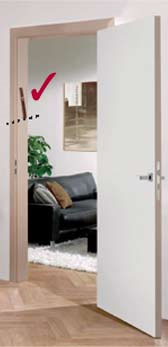
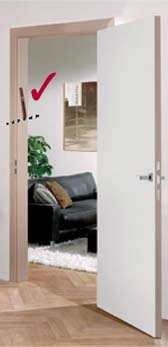
Figure 1A
The mezuzah is placed on the right hand side of the door as you enter. The mezuzah should be affixed on a slight angle with the top of the mezuzah toward the inside of the room and the bottom pointed toward the outside (Ashkenazic custom).
It should be affixed in the lower part of the upper-third of the doorpost. In most homes, the doors are approximately 78 inches high. Hence, the lowest permissible height should not exceed twenty six inches from the top.
Figure 1B
The Mezuzahs should not be placed lower than the upper third, nor should it be placed within four inches from the lintel.
One is obligated to attach a mezuzah to a doorway only when the doorway has two doorposts and a lintel connecting the doorposts. If these conditions do not exist, an observant Rabbi should be consulted to determine whether or not that entryway may still require a mezuzah.
WHAT IF MY DOORPOST IS VERY HIGH OR VERY LOW?
A: If your door is much higher than 78 inches (90 inches or higher), many Rabbis would instruct you to affix the mezuzah according to shoulder height, even if the shoulder-height is lower than the upper third of the doorway.
If the doorpost is very low, an observant Rabbi should be consulted in order to determine where the mezuzahs should be mounted.
CAN I MOUNT THE MEZUZAH LOWER THAN THE UPPER THIRD OF THE DOORPOST, IN ORDER TO ENABLE MY CHILDREN TO REACH AND KISS THE MEZUZAH?
No.
IF A DOORWAY CAN BE UTILIZED AS AN ENTRANCE FROM EITHER SIDE, HOW DO I THEN DETERMINE WHAT IS CONSIDERED THE RIGHT (AS OPPOSED TO LEFT) SIDE? WHAT IF I’M NOT SURE IF ALL OF MY MEZUZAHS ARE AFFIXED PROPERLY?
The laws defining the terms ‘entrance’ and ‘exit’ are multifarious and complex. It is therefore advisable to have a reliable observant Rabbi visit your home to make that determination. Please send a picture of your doorpost and describe it to the best of your ability. Please fax it to: 647-201-0261 or email it to torontomezuzah@gmail.com
SHOULD I ALWAYS AFFIX MY MEZUZAH AT THE HORIZONTAL CENTER OF MY DOORPOST?
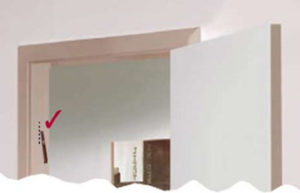
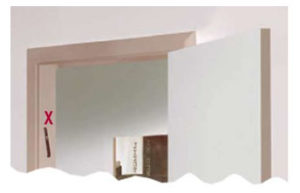
No. The mezuzah should be mounted on the outermost hand breadth (approximately 3.25 inches) from the outside of the doorpost. If the doorpost or archway is very wide, caution should be exercised not to mount the mezuzah in the center of the doorway. Use the above measurement to determine the proper placement of the mezuzah.
However, when there is a protrusion along the height of the doorpost, some Rabbis would advise you to affix the mezuzah on the protrusion.
AM I OBLIGATED TO USE NAILS OR SCREWS TO MOUNT THE MEZUZAHS?
No. You may, also use glue or mounting tape. For this purpose, regular scotch tape or masking tape is not permitted.
WHAT MUST I DO WITH OLD MEZUZAH CASES, OLD MEZUZAH WRAPPINGS OR NAILS PREVIOUSLY USED FOR MEZUZAHS?
Nails, screws and tape (that were used for mezuzahs) may be discarded. However, mezuzah cases and mezuzah wrappings should be treated as “SHAIMOS”, and require interment after their use.
IS THERE A PROBLEM WITH CLEAR LUCITE CASES?
It depends where the mezuzah will be placed. You may not use a lucite case:
• If it faces a bathroom.
• On a doorpost or archway inside a bedroom door.
• On any doorpost or archway of a room where babies’ diapers are changed.
• In a laundry room
DO ALL MEZUZAHS HAVE TO BE RETURNED TO THE SAME DOORPOST?
It is Halachically preferred to have all of the mezuzahs returned to their original doorposts or at least to the same type of entrance way (i.e. from one bedroom door to another, or from one archway to another).
A practical suggestion for anyone removing his or her mezuzahs is to label each mezuzah case with a number (using masking tape or the like). The identical number is then taped on the doorpost itself. You must remember to request the scribe to replace all mezuzahs in their original cases. When the mezuzahs have to be remounted, match the numbers from your cases to the numbers on the doorposts.
WHO MAY AFFIX MEZUZAHS ON MY BEHALF?
Any Jew above the age of Bar/Bas Mitzvah may affix a mezuzah on your behalf. A non-Jew may not.
BE CAUTIOUS: If you are having your home remodeled, make certain that non-Jewish workers do not remove and remount your mezuzahs.
When to affix a Mezuzah:
Obligation to affix a Mezuzah
IF I AM PURCHASING A HOME, WHEN DOES MY OBLIGATION TO MOUNT MEZUZAHS BEGIN?
Purchased homes require mezuzahs, with the blessing, immediately when moving in.
IF I AM RENTING A HOME, WHEN AM I OBLIGATED TO MOUNT THE MEZUZAHS?
You have a 30-day grace-period (outside of Israel only). It is also preferred to wait until after the thirty days (the night of the 31st) before reciting the blessing. Therefore, some authorities will suggest not affixing any mezuzahs until the 30-day period is up.
Some have the custom to affix all of the mezuzahs immediately upon occupancy, without reciting the blessing. Once the 30-day grace-period has elapsed, one of the mounted mezuzahs (from a room that has a door) should be removed, checked and replaced. That mezuzah may also be replaced with a new or upgraded one. The proper blessing is then recited. Others have the custom of affixing the mezuzahs immediately upon occupancy using tape, and nailing them in on the 31st day. The first mezuzah that is nailed in should be on a room that has a door, and the bracha is recited at that time.
WHEN DO I BEGIN COUNTING THE 30 DAYS?
You should begin counting from the day you move in, or the day that you begin storing items in the house.
Obligation by location
WHICH ENTRANCES ARE EXEMPT FROM MEZUZAHS?
• Bathrooms and shower rooms.
• Storage rooms that are less than four cubits long and four cubits wide (approximately 61/2 ft. x 6 1/2 ft. or 37 square foot).
• A room with an area of sixteen square cubits, that has one side less than a cubit long. (i.e. 1’x 40’)
• Any door that’s used only as an Emergency exit.
A small room leading into a larger room (i.e. a foyer) requires a mezuzah. There are other small rooms that may require mezuzahs as well, therefore an observant Rabbi should be consulted to determine whether a mezuzah is required.
DO I REQUIRE MEZUZAHS IF MY HOME IS BEING RENOVATED OR PAINTED?
Mezuzahs do not need to be mounted if this will interfere with the construction. However, a practical suggestion would be to use mounting tape to facilitate affixing or removing mezuzahs during construction.
A WORD OF CAUTION:
If you are constructing a door in an archway that has a mezuzah of its own, you must remove the mezuzah before installing the door. After the door is properly installed, you should remount the Mezuzah with a blessing. Never mount a mezuzah on a doorpost before the doorpost is installed.
WHAT IF I NEVER USE THAT DOOR? WHAT IF THE DOOR IS BLOCKED BY FURNITURE?
According to the majority of opinions, only unused doors that are sealed closed (doors actually nailed to the door frame) are exempt from mezuzahs. Entrances blocked by furniture or doors that are usually kept locked require mezuzahs.
DO GARAGE DOORS, BOILER ROOMS, ATTICS, OUTDOOR SHEDS, OR CRAWL SPACES REQUIRE MEZUZAHS?
According to many rabbinical authorities, mezuzahs are required on all garage doors (including garage overhead doors), boiler rooms, outdoor sheds, and even crawl spaces, provided that they comply with the required measurements (approximately 37 square feet).
At the entrance to a crawl space, the doorposts themselves must be at least 10 hand breadths high (approximately 32 inches) and four hand breadths wide.
An attic also requires a mezuzah unless it has a horizontal doorway.
HOW DO I MEASURE 37 SQ. FOOT IN A BOILER ROOM?
The measurement of 37 square feet should NOT include the space being used by permanently mounted appliances or fixtures (e.g. boilers, cabinets).
ARE MEZUZAHS REQUIRED ON DOORS WHERE REFUSE IS STORED?
No. The same will apply for any room with a strong odor.
AM I REQUIRED TO AFFIX A MEZUZAH ON A DOOR LEADING TO AN EMPTY ROOM WHICH IS NOT BEING USED AT ALL?
Some authorities exempt the placing of a Mezuzah on such rooms.
WHAT ABOUT BALCONIES OR SUN PORCHES (FROM UPPER FLOORS)?
Balconies and porches require mezuzahs. There is a difference of opinion whether the mezuzah is to be placed on the right side of the door leading into the house, or on the right side of the door leading onto the porch.
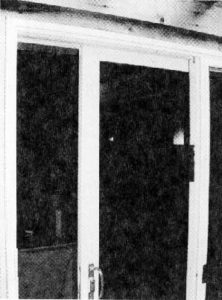
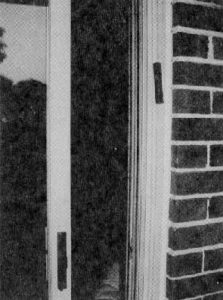
I LIVE IN A HOUSE WITH SEVERAL SLIDING DOORS LEADING INTO THE BACK YARD. SHOULD I AFFIX THEIR MEZUZAHS THE IDENTICAL WAY ON ALL OF THE SLIDING DOORS?
No. It depends if the sliding door slides from right to left or from left to right.
If it slides from right to left (when facing the inside of your home) then the mezuzah is placed on the extreme right side as you enter the home.
If however the door slides from left to right (when facing the inside of your home) then you must affix the mezuzah on the right side of the doorpost, not on the extreme right side of the door frame.
DO I NEED A MEZUZAH AT MY WORKPLACE?
Yes. In addition to private places of residence, mezuzahs must also be placed in businesses and stores without a blessing. If you’re working for a non-Jew and you are renting space from him, a mezuzah should be affixed on your office door without a blessing. Some authorities add, that the obligation is only if one eats there as well. However, if you are not renting the space, and there is always a possibility that your office space could be relocated without notice, then you would be exempt from affixing a mezuzah.
AM I OBLIGATED TO AFFIX A MEZUZAH ON A ROOM THAT IS SHARED WITH ANOTHER PERSON?
The opinions vary when sharing with a non-Jew. It is therefore recommended to put up a Mezuzah, provided the non-Jew will not be offended and will allow you to put it up. If sharing with a Jew, it is an obligation upon each partner/tenant to affix that Mezuzah.
IS A LANDLORD OBLIGATED TO PUT MEZUZAHS IN A BUILDING WHERE NOT ALL THE TENANTS ARE JEWISH?
There’s no obligation on the rented apartments but there is an obligation on all the common areas as well as the vacant apartments that are used by the landlord.
I HAVE A LIVE-IN MAID. AM I REQUIRED TO PUT A MEZUZAH ON HER DOOR?
Yes, providing that upon your discretion, her room may be changed to another location in the house at any given time.
DOES A WASHING ROOM (OUTSIDE A LAVATORY) REQUIRE A MEZUZAH?
A mezuzah is required providing that the washing room is 37 sq. foot and that there is another door separating the lavatory from the washing area.
Proper placement of Mezuzah
WHAT IF I AM IN THE MIDST OF MOVING AND I TEMPORARILY OWN TWO HOMES. WHICH ONE REQUIRES MEZUZAHS?
If you are actually living in both homes, or storing items in both homes, then you are obligated to have mezuzahs in both homes. We therefore recommend that you take advantage of MezuzahWay‘s “mezuzah rental service.” We will be happy to rent you mezuzahs until you sell or rent your existing home. For more information, please call: 647 201 0261.
AM I OBLIGATED TO LEAVE MY MEZUZAHS UP AFTER MOVING?
When moving to another house or apartment, mezuzahs should not be removed, unless:
• The new tenant is a non-Jew,
• A new tenant did not move in, and there is concern that were the mezuzahs to be left behind, in all probability they would become defaced.
MAY I REMOVE MY MEZUZAHS IF THE NEW JEWISH TENANT HAS HIS OWN MEZUZAHS?
A: It is preferred that the new tenant or owner should remove your mezuzahs, or he should at least instruct you to remove your mezuzahs. This halacha is a very serious matter and should not be treated lightly. Rather, an observant Rabbi should instruct you what to do.
WHAT IF THE NEW OWNER IS JEWISH AND HE WANTS MY MEZUZAHS, AM I OBLIGATED TO LEAVE ALL OF MY MEZUZAHS BEHIND?
Yes. You may, however exchange the mezuzahs themselves for less expensive ones, providing that they are 100% kosher. The mezuzah cases may certainly be exchanged for the least expensive mezuzah covers.
You may also demand the new owner or tenant to pay you for the mezuzahs. He will then be obligated to compensate for the mezuzahs at fair market value. If he refuses to pay for them, an observant Rabbi should be contacted. This Halacha is a very serious matter.
WHAT IF I NEED MEZUZAHS FOR A SECOND HOME WHILE MY HOUSE IS UNDER CONSTRUCTION, OR A SECOND HOME USED OCCASIONALLY FOR VACATIONING?
If the second home is a rental, mezuzahs are required only if living there for more than thirty days. In the case of construction, we recommend that for that time period you avail yourself of the We therefore recommend that you take advantage of MezuzahWay‘s “mezuzah rental service.” For more information, please call: 647 201 0261.
DOES A TRAILER, MOBILE HOME OR A BOAT WITH LIVING QUARTERS REQUIRE A MEZUZAH?
Yes. If you are renting them, you have the standard grace-period of thirty days and if they were purchased, then mezuzahs should be affixed immediately following the sale. Nevertheless, a brocha should not be recited when affixing these mezuzahs.
WHAT ABOUT A CAR OR A TRUCK?
Cars and trucks are both exempt from mezuzahs. Some have a custom of placing a mezuzah in the cars’ glove compartment for the purpose of “shmeerah” (protection). It is permissible to do so, but let it be known that this is merely a custom and it is neither a Torah nor a Rabbinical obligation
Blessings for placement of Mezuzah
WHAT IS THE BLESSING TO BE RECITED PRIOR TO AFFIXING A MEZUZAH?
Prior to affixing a mezuzah upon a doorpost (which has a door), the following blessing should be recited:



Barukh atah Adonai, Eloheinu, melekh ha’olam asher kidishanu b’mitz’votav v’tzivanu lik’bo’a m’zuzah.
Translation: Blessed are You, L-rd our G-d, King of the universe, who has sanctified us with His commandments and commanded us to affix a mezuzah.
Although many mezuzahs will be affixed, one does not recite “Likboa Mezuzot” (in the plural).
HOW MANY BLESSINGS DO I MAKE WHEN I AM NOT PUTTING UP ALL OF THE MEZUZAHS AT ONCE?
If more than one mezuzah is being affixed at one time, only one blessing is recited. However, if you will put them up on separate days, additional blessings will be required on each day.
One should also refrain from talking until all the mezuzahs are mounted.
DOES THE BLESSING “SHEHECHEYANU” NEED TO BE RECITED?
No. The blessing “Shehecheyanu” is never recited when affixing mezuzahs.
ARE THERE ANY DOORS THAT REQUIRE A MEZUZAH BUT DO NOT REQUIRE A BLESSING?
Yes, there is no need for a blessing to be recited when affixing mezuzahs to:
• Entrances of garages and storage rooms
• Doorways or archways that have no actual doors
• A room whose length is less than four cubits, but the total area is at least sixteen cubits square. (i.e. 4 x 9 1/2 feet or 3 x 12 1/2 feet)
In all the aforementioned, the blessing should be recited whilst affixing a mezuzah to an entrance that has a door, such as an exterior entryway or bedroom door. The mezuzahs remaining are afterwards placed on the archways, etc.
Blessings are also not recited on mezuzahs:
• If the rooms are shared with a non-Jew
• At one’s workplace
DO I RECITE A BLESSING WHEN REMOUNTING THE MEZUZAHS?
Recite the blessing only if the mezuzahs were off the doorposts for at least one night. If when you’re remounting the mezuzahs, you are also adding new mezuzahs, it is then preferred to recite the blessing on the new one (providing that it is mounted on a door that requires a blessing).
AM I REQUIRED TO RECITE A BLESSING WHEN REMOUNTING A MEZUZAH AFTER IT FALLS OFF FROM THE DOORPOST?
Yes. This applies even in a case when the mezuzah is affixed immediately after it falls down.
Safrut
Safrut—the writing of STaM (Sefer Torah, Tefillin & Mezuzot)—is a highly technical skill, one that can be practiced with reliability only by scribes who have been properly trained and who have mastered the numerous halachic details involved.
Since the details of the letters and the process of their writing are many and complex, the scribe must attain full mastery of this section of the law. He must constantly study and review them,. If the scribe is ignorant of a law relating to the exact form of a letter, it will become apparent upon inspection of his writing. But if he is ignorant of the exact procedure to be used in forming the letters, all of the Mezuzot etc. which he writes can be unfit. This is why quality Mezuzot etc. can be so costly.
Making MEZUZAHS AFFORDABLE
Our Mission at Mezuzahway.Ca is for every Jewish Home in Canada to have kosher Mezuzos affixed properly to their doorposts ,we therefore offer flexible payment plans and promise to assist in every way possible. We also offer certified 2nd hand Mezuzot at about half the price of new ones, all in order to make this special Mitzvah possible for every Jewish person.


